Functions used only in Revenues and Operational Expenditures
There are three sets of functions relating to the conversion or resources within energyPRO. Those are:
- Functions measuring on the system border
- Functions measuring on conversion unit level
- Other Functions
In the figure below the system is defined as everything placed within the outer frame. By other words, the “functions measuring on the system border” is the functions measuring the flow passing this border, that is import or export.
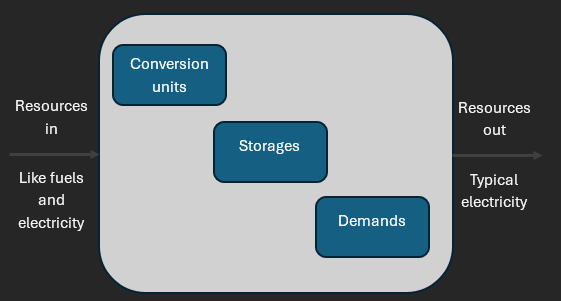
In practice the system border is the electrical grid or a specified transformer station, where the interaction between the considered energy system and the outside world is measured. It could for instance be a meter measuring the amount of natural gas entering the system.
The functions measuring on conversions unit level are strictly related to the specific conversion units, storages and demands described within the system. It could be a specified boiler, CHP-unit or a specified demand. Below you will find a description of the single functions.
When modelling economy it is important to realize that the model is timestep based. While modelling with peak-function the monthly or annual period is used. Not being aware of this fact might result in misleading values.
Functions measuring on the system border
These functions consider the energy system as a black box, and are only dealing with energy and power crossing this border, see the figure below. The arrows are indicating the flows passing the system border.
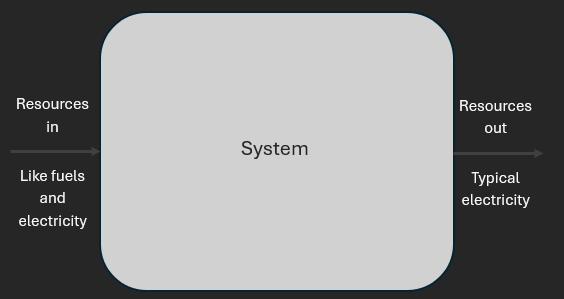
This “System” -functions can be interpreted as meters placed on the system border measuring flows crossing the system border.
The functions are for instance valuable in situations, where payments are independent of which unit it is concerning.
| Name | Returns | Typical Unit |
|---|---|---|
| Import(MARKET;TARIFF PERIOD) | Resource imported by the market | MWh/month |
| Export(MARKET;TARIFF PERIOD) | Resource exported to the market | MWh/month |
| ImportAcc(MARKET;PERIOD) | Accumulated import by market within the period, year or month | MWh |
| ExportAcc(MARKET;PERIOD) | Accumulated export by market within the period, year or month | MWh |
| ImportPeak(MARKET;PERIOD) | Peak value for import by market within the period, year or planning period | MW/month |
| ExportPeak(MARKET;PERIOD) | Peak value for export by market within the period, year or planning period | MW/month |
Import
Returns the resource imported per timestep from the specified market in a specified “tariff period”. If no tariff period is specified it is all timesteps.
Syntax Import(MARKET;TARIFF PERIOD)
Argument Description
MARKET The name of the market.
          TARIFF PERIOD      The name of the tariff period as specified if the market is a fixed tariff market.
                             If this is omitted all timesteps is included
Returning value Timestep amount of resource imported from the specified market
Returning unit (Energy measuring unit if available else Resource measuring unit)/timestep
Description
In every calculated time step within a month the amount of resource imported from the specified market is calculated.
Import() calculates the amount imported as the resource produced subtracted the resource consumed by production units and consumers within the system. If positive in a time step the value for that time step is set to zero, otherwise it is added to the amount of imported resource.
Also see Export.
Examples
Import(Electricity market)
Import(Fixed tariffs; Highload)
Import(Natural Gas Market)/CalorificValue(Natural Gas)
Export
Returns the resource exported per timestep to the specified market in a specified “tariff period”. If no tariff period is specified it is all timesteps.
Syntax Export(MARKET;TARIFF PERIOD)
Argument Description
MARKET The name of the market.
          TARIFF PERIOD      The name of the tariff period as specified if the market is a fixed tariff market.
                             If this is omitted all timesteps is included
Returning value Timestep amount of resource exported from the specified market
Returning unit (Energy measuring unit if available else Resource measuring unit)/timestep
Description
In every calculated time step within a month the amount of resource exported to the specified market is calculated.
Export() calculates the amount exported as the resource produced subtracted the resource consumed by production units and consumers within the system. If negative in a time step the value for that time step is set to zero, otherwise it is added to the amount of exported resource.
Also see Import.
Examples
Export(Electricity market)
Export(Fixed tariffs; Highload)
Export(Purchase of hydrogen)/CalorificValue(H2)
ImportAcc
Returns the accumulated amount of resource imported from the specified market within the period.
Syntax ImportAcc(MARKET;PERIOD)
Argument Description
MARKET The name of the market.
PERIOD Either Year or Planning Period
Returning value Accumulated amount of resource imported from the specified market
Returning unit (Energy measuring unit if available else Resource measuring unit)/timestep
Description
In every calculated time step within a month the amount of resource imported from the specified market is calculated.
Import() calculates the amount exported as the resource produced subtracted the resource consumed by production units and consumers within the system. If positive in a time step the value for that time step is set to zero, otherwise it is added to the amount of imported resource.
ImportAcc() returns the accumulated value hereof for the actual year or for the planning period in calculation.
Also see ExportAcc.
Examples
ImportAcc(Electricity market;PlanningPeriod)
ImportAcc(Fixed tariffs;Annual)
ImportAcc(Purchase of hydrogen;Annual)/CalorificValue(H2)
ExportAcc
Returns the accumulated amount of resource exported to the specified market within the period.
Syntax ImportAcc(MARKET;PERIOD)
Argument Description
MARKET The name of the market.
PERIOD Either Year or Planning Period
Returning value Accumulated amount of resource exported to the specified market
Returning unit (Energy measuring unit if available else Resource measuring unit)/timestep
Description
In every calculated time step within a month the amount of resource imported from the specified market is calculated.
Export() calculates the amount exported as the resource produced subtracted the resource consumed by production units and consumers within the system. If negative in a time step the value for that time step is set to zero, otherwise it is added to the amount of imported resource.
ExportAcc() returns the accumulated value hereof for the actual year or for the planning period in calculation.
Also see ImportAcc.
Examples
ExportAcc(Electricity market;PlanningPeriod)
ExportAcc(Fixed tariffs;Annual)
ExportAcc(Purchase of hydrogen;Annual)/CalorificValue(H2)
ImportPeak
Returns the peak load of resource imported from the specified market within the period.
Syntax ImportPeak(MARKET;PERIOD)
Argument Description
MARKET The name of the market.
PERIOD Either Month or Year
Returning value Peak of resource imported from the specified market in the period
Returning unit (Power measuring unit if available else Resource measuring unit)/Period
Description
ImportAcc() returns the peak value hereof for the actual year or for the planning period in calculation.
In every calculated time step within the period the peak of resource imported from the specified market is calculated.
Also see ExportPeak.
Examples
ImportPeak(Electricity market;PlanningPeriod)
ImportPeak(Fixed tariffs;Annual)
ImportPeak(Purchase of hydrogen;Annual)/CalorificValue(H2)
ExportPeak
Returns the peak load of resource exported to the specified market within the period.
Syntax ExportPeak(MARKET;PERIOD)
Argument Description
MARKET The name of the market.
PERIOD Either Month or Year
Returning value Peak of resource exported to the specified market in the period
Returning unit (Power measuring unit if available else Resource measuring unit)/Period
Description
ExportAcc() returns the peak value hereof for the actual year or for the planning period in calculation.
In every calculated time step within the period the peak of resource exported to the specified market is calculated.
Also see ImportPeak.
Examples
ExportPeak(Electricity market;PlanningPeriod)
EXportPeak(Fixed tariffs;Annual)
ExportPeak(Purchase of hydrogen;Annual)/CalorificValue(H2)
Functions measuring on conversion unit level
These functions are focused on the single elements within modelled system. This is the conversion units, storages and demands.
The functions measuring on the conversion unit level can be considered as meters placed on the single energy conversion units i.e. a specified boiler, a specified CHP-unit or an electricity demand.
Conversion units
Below is a description of the functions that are available for conversion units.
| Name | Returns | Typical Unit |
|---|---|---|
| Input(CONVERSION UNIT;RESOURCE) | Consumption of resource on conversion unit | MWh/timestep |
| Output(CONVERSION UNIT;RESOURCE) | Production of resource on conversion unit | MWh/timestep |
| InputCap(CONVERSION UNIT;RESOURCE) | Consumption capacity of resource on conversion unit | MW/month |
| OutputCap(CONVERSION UNIT;RESOURCE) | Production capacity of resource on conversion unit | MW/month |
| TurnOns(CONVERSION UNIT) | Number of turn-ons for conversion unit | Number of turn-ons |
| TurnOffs(CONVERSION UNIT) | Number of turn-offs for conversion unit | Number of turn-offs |
| LoadChange(CONVERSION UNIT) | Number of load changes for conversion unit | Number of load changes |
| HoursOfOperation(CONVERSION UNIT) | Number of hours of operation for production unit | Hours |
| FullLoadHours(CONVERSION UNIT) | Number of full load hours for production unit | Hours |
| FullLoadHoursAcc(CONVERSION UNIT) | Accumulates the full load hours over the year | Hours |
| FullLoadHoursAccAllYears(CONVERSION UNIT) | Accumulates the full load hours over the years in the planning period | Hours |
| PrivateWire_EP_CoveringOwnDemand(CONVERSION UNIT;RESOURCE) | The resource production used for covering demand | MWh/month |
| PrivateWire_EP_Exported(CONVERSION UNIT;MARKET) | The resource production used for export | MWh/month |
| PrivateWire_EP_UsedOwnProduction(CONVERSION UNIT;RESOURCE) | The resource consumption using own production | MWh/month |
| PrivateWire_EP_Imported(CONVERSION UNIT;MARKET) | The electricity production using import | MWh/month |
Input
Returns the amount of specified resource consumed on specified conversion unit.
Syntax Input(CONVERSION UNIT;RESOURCE)
Argument Description
CONVERSION UNIT The name of the specified conversion unit
RESOURCE The name of the specified resource
Returning value Amount of specified resource consumed on specified conversion unit
Returning unit MWh/timepstep
Example
Input(Boiler 1;Natural gas) returns the amount of natural gas consumed on “Boiler 1”.
Output
Returns the amount of specified resource produced on specified conversion unit.
Syntax Output(CONVERSION UNIT;RESOURCE)
Argument Description
CONVERSION UNIT The name of the specified conversion unit
RESOURCE The name of the specified resource
Returning value Amount of specified resource produced on specified conversion unit
Returning unit MWh/timepstep
Example
Output(Boiler 1;Heat) returns the amount of heat produced on “Boiler 1”.
InputCap
Returns the monthly peak resource consumption load realised on a specified conversion unit.
Syntax InputCap(CONVERSION UNIT;RESOURCE)
Argument Description
CONVERSION UNIT The name of the specified conversion unit
RESOURCE The name of the specified conversion unit
Returning value Monthly peak resource consumption load on specified conversion unit
Returning unit MW
Example
InputCap(Boiler 1;Natural gas) returns the peak consumption load of natural gas on “Boiler 1”.
OutputCap
Returns the monthly peak resource production load realised on a specified conversion unit.
Syntax OutputCap(CONVERSION UNIT;RESOURCE)
Argument Description
CONVERSION UNIT The name of the specified conversion unit
RESOURCE The name of the specified conversion unit
Returning value Monthly peak resource production load on specified conversion unit
Returning unit MW
Example
InputCap(Boiler 1;Heat) returns the peak production load of heat on “Boiler 1”.
TurnOns
Returns the monthly amount of turn-ons on a specified conversion unit.
Syntax TurnOns(CONVERSION UNIT)
Argument Description
CONVERSION UNIT The name of the specified conversion unit
Returning value Monthly number of turn-ons
Returning unit Turn-on/month
Description
TurnOns() returns monthly number of turn-ons on a conversion unit. It is used when designing operational costs.
Example
TurnOns(CHP) returns the number of turn-ons on the unit “CHP”.
TurnOffs
Returns the monthly amount of turn-offs on a specified conversion unit.
Syntax TurnOffs(CONVERSION UNIT)
Argument Description
CONVERSION UNIT The name of the specified conversion unit
Returning value Monthly number of turn-offs
Returning unit Turn-off/month
Description
TurnOffs() returns monthly number of turn-offs on a conversion unit. It is used when designing operational costs.
Example
TurnOffs(CHP) returns the number of turn-offs on the unit “CHP”.
LoadChange
Gives a cost whenever the conversion unit is changing load.
Syntax LoadChange(CONVERSION UNIT)
Argument Description
CONVERSION UNIT The name of the specified conversion unit
Returning value Number of times the load of the energy conversion unit has changed
Returning unit Load changes/month
Description
LoadChange() returns the number of times an energy conversion unit changes load. Typically, it is used for limiting fluctuating load of the energy conversion unit.
Example
LoadChange(CHP) returns the number of load changes on the unit “CHP”.
HoursOfOperation
Returns the monthly hours of operation on a specified conversion unit.
Syntax HoursOfOperation(CONVERSION UNIT)
Argument Description
CONVERSION UNIT The name of the specified conversion unit
Returning value Monthly hours of operation
Returning unit Hours of operation/month
Description
HoursOfOperation() returns monthly hours of operation on an energy conversion unit. Is used when designing operational costs.
Example
HoursOfOperation(CHP) returns the number of hours of operation on the unit “CHP”.
FullLoadHours
Returns the monthly amount of full load hours on a specified conversion unit.
Syntax FullLoadHours(CONVERSION UNIT)
Argument Description
CONVERSION UNIT The name of the specified energy conversion unit
Returning value Monthly number of full load hours
Returning unit hours/month
Description
FullLoadHours() returns monthly number of full load hours on an conversion unit.
Example
FullLoadHours(CHP) returns the number of full load hours on the unit “CHP”.
FullLoadHoursAcc
Returns the accumulated amount over a year of full load hours on a specified conversion unit.
Syntax FullLoadHoursAcc(CONVERSION UNIT)
Argument Description
CONVERSION UNIT The name of the specified conversion unit
Returning value Accumulated number of full load hours over the year
Returning unit hours
Description
FullLoadHoursAcc() returns the accumulated number of full load hours on an conversion unit. Typically, it is used when units obtain grant until a certain amount of full load hours, or for service intervals.
Example
AccFullLoadHours(CHP) returns the number of full load hours on the unit “CHP” accumulated over the year.
FullLoadHoursAccAllYears
Returns the accumulated amount over the planning period of full load hours on a specified conversion unit.
Syntax FullLoadHoursAccAllYears(CONVERSION UNIT)
Argument Description
CONVERSION UNIT The name of the specified conversion unit
Returning value Accumulated number of full load hours over the planning years
Returning unit hours
Description
FullLoadHoursAccAllYears() returns the accumulated number of full load hours on an energy conversion unit for all planning period. Typically, it is used when units obtain grant until a certain amount of full load hours, or for service intervals.
Example
FullLoadHoursAccAllYears(CHP) returns the number of full load hours on the unit “CHP” accumulated over all the planning period.
PrivateWire_CoveringOwnDemand
Returns the amount of the resource production used to cover the resource demand in the system.
Syntax PrivateWire_CoveringOwnDemand(CONVERSION UNIT; RESOURCE)
Argument Description
CONVERSION UNIT The name of the specified conversion unit
RESOURCE The name of the specified resource
Returning value The amount of produced resource used for covering own resource demand
Returning unit MWh
Description
Private_CoveringOwnDemand() returns the amount of resource produced by an conversion unit, which is used for internal demands. Typically, it is used when units are paid or have a cost for covering the internal electricity demand.
Example
PrivateWire_CoveringOwnDemand(CHP;ELECTRICITY) returns the amount of electricity production by the energy conversion unit "CHP" which is used for covering the internal demand in the system.
PrivateWire_CoveringOwnDemand() plus the amount of PrivateWire_Exported() is the total amount of resource production of "CHP".
PrivateWire_Exported
Returns the amount of the resource production exported out of the system.
Syntax PrivateWire_Exported(CONVERSION UNIT; MARKET)
Argument Description
CONVERSION UNIT The name of the specified conversion unit
MARKET The name of the specified market
Returning value The amount of produced resource exported on market
Returning unit MWh
Description
PrivateWire_Exported() returns the amount of resoure produced by an conversion unit, which is exported on a market. Typically, it is used when units are paid or have a cost for exporting electricity.
Example
PrivateWire_Exported(CHP;ELECTRICITY MARKET) returns the amount of electricity production by the energy conversion unit "CHP" which is used for exporting on Electricity Market.
PrivateWire_CoveringOwnDemand() plus the amount of PrivateWire_Exported() is the total amount of resource production of "CHP".
PrivateWire_UsedOwnProduction
Returns the amount of the resource consumption using resource produced in the system.
Syntax PrivateWire_UsedOwnProduction(CONVERSION UNIT; RESOURCE)
Argument Description
CONVERSION UNIT The name of the specified conversion unit
RESOURCE The name of the specified resource
Returning value The amount of produced resource used for covering own resource demand
Returning unit MWh
Description
Private_CoveringOwnDemand() returns the amount of resource produced by an conversion unit, which is used for internal demands. Typically, it is used when units are paid or have a cost for covering the internal electricity demand.
Example
PrivateWire_CoveringOwnDemand(CHP;ELECTRICITY) returns the amount of electricity production by the energy conversion unit "CHP" which is used for covering the internal demand in the system.
PrivateWire_CoveringOwnDemand() plus the amount of PrivateWire_Exported() is the total amount of resource production of "CHP".
Demands
In Table 45 is found the function that are used for getting the demands
| Name | Returns | Typical Unit |
|---|---|---|
| Demand(DEMAND) | Demand of the named demand | MWh/month |
| Demand(RESOURCE) | All demands of the resource | MWh/month |
| PeakDemand(DEMAND) | The peak demand | MW/month |
Demand(DEMAND)
Returns the per timestep demand.
Syntax Demand(DEMAND)
Argument Description
Demand The name of the specified demand
Returning value The timestep demand
Returning unit MWh/month
Description
Demand() returns the demand by timestep.
Example
Demand(District heating demand) returns the demand named “District heating demand”.
Demand(RESOURCE)
Returns the per timestep aggregated demands of the resource.
Syntax Demand(RESOURCE)
Argument Description
Resource The name of the resource
Returning value The aggregated demands of the resource
Returning unit MWh/month
Description
HD() returns the aggregated demands of the resource.
Example
Demand(Heat) returns the per timestep demands of the resource “Heat”.
DemandPeak
Returns the monthly peak of a specified demand.
Syntax DemandPeak(DEMAND)
Argument Description
Demand The name of the specified demand
Returning value The monthly peak demand
Returning unit MW/month
Description
DemandPeak() returns the monthly peak demand.
Example
DemandPEak(Electricity Demand) returns the monthly peak of demand named “Electricity Demand”.
Other Functions
| Name | Returns | Unit |
|---|---|---|
| CalorifcValue(FUEL) | Calorific value of the fuel | MWh/unit |
| HeatRejection(SITE) | Heat rejection per site or all sites | MWh/Month |
| Index | Monthly value of specified index | - |
| CO2FactorImport | CO2 factor on imported resource from the market | g/kWh |
| CO2FactorExport | CO2 factor on Exported resource to the market replacing otherwise produced CO2 | g/kWh |
| IfMonth(MONTHNO) | Returns the number 1 for month no, 0 for others | - |
| QI(Value1;Value2) | Quality Index, UK | |
| <TimeSeriessymbol>(_) | Actual “Timeseries”-value | - |
| UnitOfDemand(DEMAND) | Calorific value for the demand (If the unit e.g. are GJ the function will return 0,2777777 MWh/GJ) | MWh/unit |
| WorkOfPumps(TRANSMISSION) | The energy used by pumps to transmit heat through the transmission | MWh/Month |
| TimeStepsInMonth | The number of timesteps in the month | - |
CalorificValue
Returns a conversion factor from MWh to the original unit of the CalorificValue used when defining a specified fuel.
Syntax CalorificValue(RESOURCE)
Argument Description
FUEL The name of the specified fuel or resource
Returning value The conversion Factor
          Returning unit     MWh/unit
                             Where unit is the original unit used when defining the specified fuel.
Description
CalorificValue() returns a conversion factor from MWh to original unit of the HeatValue used when defining a specified fuel. This function is normally used for converting the used amount of fuel in MWh to its original unit.
Example
CalorificValue(Natural gas) Consider that the calorific value of the fuel “Natural gas” is defined as \(11 kWh / nM^3\). Then the function will return \(1 MWh / 11 kWh / Nm^3\) pr \(MWh\) equal to 1/11000 \(MWh / Nnm^3\).
HeatRejection
Returns the monthly amount of heat rejection realised in a specified site or in all sites.
Syntax HeatRejection(SITE)
Argument Description
SITE The name of the specified site. "All Sites" returns the accumulated amount for all sites.
Returning value The monthly heat rejection per site or all sites
Returning unit MWh/month
Example
HeatRejection(Main site)
<Timeseriessymbol>(_)
Returns the actual value of the time series
Syntax <Timeseriessymbol>(_)
Argument Description
(_)
Returning value The actual value of the time series
Returning unit Unit of the time series
Description
Timeseriessymbol() returns the average value in the timestep of the time series specified with its symbol.
Example
T(_) returns the average value of the specified time series with symbol “T”.
CO2FactorImport
Returns the the CO2 factor per energy measuring unit on import from the specified market.
Syntax CO2FactorImport(MARKET)
Argument Description
MARKET The name of the market
Returning value The CO2 Factor
Returning unit g/kWh (is specified on the market)
Description
CO2FactorImport() returns the CO2 factor per energy measuring unit of the imported resource. This function is normally used for calculating the CO2 impact of imported electricity or fuels.
Example
Import(Natural gas Market)CO2FactorImport(Natural gas Market)*. The imported natural gas is multiplied with the CO2 factor for import giving the CO2 impact of the imported fuel.
CO2FactorExport
Returns the the CO2 factor per energy measuring unit on export to the market.
Syntax CO2FactorExport(MARKET)
Argument Description
MARKET The name of the market
Returning value The CO2 Factor
Returning unit g/kWh (is specified on the market)
Description
CO2FactorExport() returns the CO2 factor per energy measuring unit of the imported resource. This function is normally used for calculating the CO2 impact of replacing electricity on the grid or market with a given CO2-impact.
Example
Export(Spot market)CO2FactorExport(Spot market)*. The exported electricity is multiplied with the CO2 factor for export giving the CO2 impact of replacing electricity on the grid or market with a given CO2-impact.
IfMonth
IfMonth is a function returning the value 1 in chosen month and zero in the other months.
Syntax IfMonth(MONTHNO)
Argument Description
MONTHNO Month number in year, 1 = Januray, 2 = February etc.
Returning value 1 if true, 0 if false
Returning unit -
Description
IfMonth returns 1 if the month number in function match the actual month in calculation otherwise it returns 0 (zero). This function is used in situations where an annual payment takes place in a specific month.
Example
IfMonth(3). This function returns the value 1 if the calculation month is March and otherwise the value 0.
UnitOfDemand
Returns a conversion factor from MWh to the original unit used when defining a specified demand.
Syntax UnitOfDemand(DEMAND)
Argument Description
DEMAND The name of a specified demand
Returning value The conversion factor
          Returning unit     MWh/unit
                             Where unit is the original unit used when defining the specified fuel.
Description
UnitOfDemand() returns a conversion factor from MWh to original energy unit used when defining a specified demand. This function is normally used for converting a demand in MWh to its original unit.
Example
UnitOfDemand(HeatDemand 1). Consider that the used “unit of demand” is GJ. Then the function will return 0.2777777 MWh/GJ.
QI
Quality index is especially used in Great Britain to describe the “Quality” of an energy conversion plant.
It has two syntax modes. Syntax 1, where you only specify the Quality coefficient for power and the Quality coefficient for heat. Hereby all the energy conversion units and heat rejection is taking into account.
Syntax 2, where you beside the quality coefficients also specify the energy conversion units and heat rejection units, you want to be included in the QI calculation.
Syntax 1 QI(el-factor;heat-factor)
Syntax 2 QI(el-factor;heatfactor;energy conversion unit 1; energy conversion unit 2; heat rejection unit.....)
Argument Description
el-factor The quality coeffecient for power
heat-factor The quality coeffecient for heat
energy conversion unit Any number of ennergy conversion units can be included
heat rejection unit The heat rejection units to be included
Returning value Index
Returning unit None
Description
QI defines the Quality Index as: $$ QI(el-factor;heat-factor) = el-factor * Efficiency_{power} + heat-factor *Efficiency_{heat} $$
Where EP is the annual power supply of included energy conversion units (\(MWh_e\))
HP= annual heat supply of included energy conversion units (\(MWh_{th}\))
FC= annual fuel use of included energy conversion units (MWh)
HR= annual heat rejection of included heat rejection units (MWh)
El-factor is a coefficient for power, related to alternative electricity supply options. Similarly, heat-factor is a coefficient for heat generation, related to alternative heat generation options. These coefficients vary to reflect conditions affecting particular classes of CHP plant. For a project, which supplies electricity only, \(Efficiency_{heat}\) is zero. For a project which supplies heat only, \(Efficiency_{power}\) is zero.
QI is annual based. This means the result is only present in the last month of the calculation year.
Example
QI(195;113)
Result
Returns the Result from the income statement (after taxation).
Syntax Result
Argument Description
Returning value The result from the income statement of the actual fiscal year
Returning unit currency
WorkOfPumps
WorkOfPumps is a function reflecting the work of pumps for the specified transmission based on the pressure calculation in each time step.
Syntax WorkOfPumps(TRANSMISSION)
Argument Description
Transmission Name of transmission
Returning value The energy used to pump the water through the transmission
Returning unit MWh
Description
WorkOfPumps() returns the work of pumps for transmitting heat through the transmission line, both supply and return. This function is not taking into account the pump of work from resistance in bends and valves.
Example
WorkOfPumps(New town_Solar Site). This function returns the amount of energy needed to pump heat through the transmission "New town_Solar Site".
TimestepsInMonth
TimestepsInMonth is a function reflecting the number of timesteps in the month. This function is used when having a fixed annual payment, to be distributed over the number of timesteps.
Syntax TimestepsInMonth
Argument Description
Returning value The number of timesteps in the month
Returning unit -
Description
TimestepsInMonth() returns the number of timesteps in the month.
Example
1/12/(TimestepsInMonth). This function returns the number of timesteps in the month.